
Competition between startups is hotting up
Nov 10th 2025| By Vijay Vaitheeswaran, Global energy & climate innovation editor, The Economist
IF YOU WANT a breathtaking display of the grandeur of nature’s past, visit Zion. This national park in south-western Utah, with its striking red canyons and craggy peaks, is one of America’s most visited outdoor places. If you want a glimpse of the power of harnessing nature in the future, you need to travel north to a more desolate spot. Just outside the town of Milford you will find a blustery plain ringed by ridges where an energy revolution is quietly taking place.
This is where Fervo Energy, a buzzy startup backed by Bill Gates, Google and other high-powered investors, is showing that techniques borrowed from the oil business could transform the moribund geothermal industry into an energy source bigger than nuclear power. Apart from in hot zones like Iceland and New Zealand, conventional geothermal power has largely been limited to the few places where intense heat, pressure and water are found close enough to the surface to be tapped by conventional drilling techniques. These limitations explain why, over a century since its first use to make power, in Italy, geothermal provides less than 1% of global electricity.
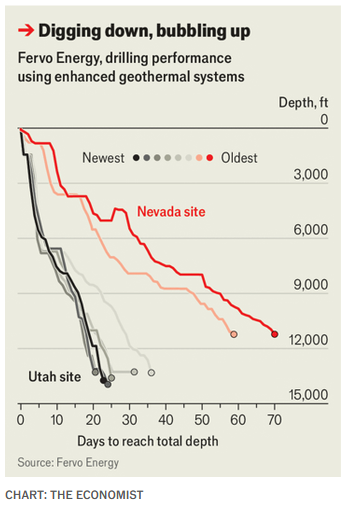
Pioneers of “enhanced geothermal” techniques believe they can apply innovations from the shale industry, such as fracking and multilateral drilling, to enable geothermal almost anywhere. At the forefront is Fervo. The firm proved that its technology works at a pilot plant in Nevada. Now it has scaled up operations dramatically at the Utah site and, in doing so, shown a 70% reduction in drilling time year on year (see chart) while achieving high temperatures and flow rates. In 2026 it will start to deliver energy to the grid. Fervo is contracted to supply 320 megawatts of power to Southern California Edison, a utility, in the largest-ever commercial contract for geothermal power.
Fervo has competitors in the enhanced-geothermal sector, but other novel approaches are also making headway. “Closed loop” systems do not consume water or rely on fracking. Rather, they use more drilling and more pipes (thus raising costs) to create an enclosed system for circulating a working fluid at depth. Eavor, a pioneering Canadian firm, plans to deliver heat and power soon using this approach at a facility in Bavaria in southern Germany. xgs Energy, an American closed-loop startup, struck a deal recently to supply power to Meta, which owns Facebook.
Unlike wind and solar, geothermal energy provides “firm” power around the clock. Sage Geosystems, an American startup which also has a deal with Meta, is pioneering its use for energy storage. In Texas the firm pumps water into fracked wells under high pressure to store energy, and releases it to turn a turbine as needed, in effect creating a giant battery.
America’s Department of Energy has revised its outlook to suggest that by 2050, geothermal technologies, which generate less than four gigawatts (gw) today, could provide up to 300gw of energy, or roughly triple the current output of the country’s entire nuclear fleet. The International Energy Agency has revised its long-term forecast to suggest that the global potential of geothermal by 2050 is over 800gw, up from 15gw today. 2026 looks set to mark the start of the great geothermal renaissance. ■