
It could be a tough time for leaders tackling both
Nov 10th 2025| By Sarah Birke, Bureau chief for Mexico, Central America and the Caribbean, The Economist
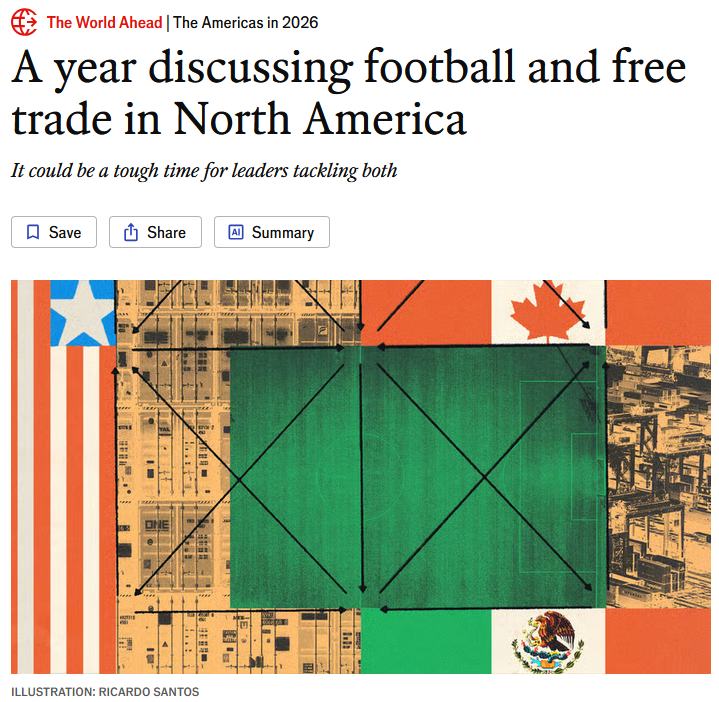
THE COMING year gives countries in North America good reason to strengthen ties and celebrate together. In June Mexico, the United States and Canada will co-host the men’s football World Cup. Then, in July, the three countries will start a review of their free-trade deal, which makes the region both richer and more competitive. Could both be easy wins?
If only. Donald Trump casts a shadow over both events. He has threatened to shift some football matches within the United States away from cities he considers dangerous. (He lacks the authority to do so, but that may not stop him trying.) The event already underlines who leads the three-way partnership: the United States will host 78 of the 104 matches, compared with just 13 each in Mexico and Canada. All three teams qualify automatically as hosts, but will be in different initial groups, so would not meet unless they proceed to the knock-out stages.
The review of the United States-Mexico-Canada Agreement (usmca) will be uglier, and the three sides could be kicking chunks out of each other from the start. They must decide whether to extend the deal for a further 16 years; failure to do so could lead to annual reviews until it automatically lapses in 2036. Less likely, any of the parties can withdraw with six months’ notice. Mr Trump negotiated the deal in his first term to replace the North American Free Trade Agreement (nafta), which he called “the worst deal ever”. Yet he often seems little fonder of usmca, favouring his “America First” vision.
Much is at stake. The North American economic area is the world’s largest free-trade bloc by output, with a combined gdp of $31trn, or 28% of global gdp. Intra-regional trade exceeds $2trn a year, more than the cptpp, signed by mainly Asia-Pacific countries, and second only to the European Union. North America accounts for 14% of global exports.
The three economies are complementary: the United States provides capital, innovation and scale; Canada, natural resources and energy; and Mexico, labour and manufacturing. Together they form supply chains none could replicate alone. Cars and appliances cross borders several times during manufacturing. This integration has helped the bloc compete with Asia, especially China. Yet to compete even better, deeper co-operation is needed. Disrupting North America’s supply chains would raise prices for consumers and undercut the competitiveness of the region’s global exports. The three sides could be kicking chunks out of each other from the start
Mexico is most exposed to disruption of usmca: over 80% of its exports go north. But the other two would also suffer. Three-quarters of Canada’s exports go to the United States. Almost a quarter of American exports go to its two neighbours, often from politically sensitive sectors such as agriculture. Mr Trump’s tariffs—some imposed on goods outside usmca, others within it—have already hurt many.
This all makes usmca’s renewal likely, but the negotiation could be fraught. Mr Trump’s concerns include tightening rules on how much of a vehicle must originate in the region to qualify for tariff-free trade. Next come fears over China. Mr Trump sees Mexico as a back door for Chinese firms entering regional supply chains. Other complaints include non-tariff barriers affecting dairy exports to Canada, and energy policies in Mexico that favour state firms.
Mexico and Canada are taking different approaches. Canada has criticised the “rupture” Mr Trump is causing. Mexico’s president, Claudia Sheinbaum, has sought to earn his respect while conceding to many demands. Mexico has, for example, created a body to vet Chinese investment and proposed tariffs on imports from countries with which it has no free-trade agreement (also aimed at China). Both say they will make more within their own borders.
Domestic politics will complicate matters further. Mr Trump faces midterm elections in November and will be playing to his base. He is watching the region closely as he clamps down on migration and drug-trafficking. Mexico has helped cut the number of migrants, but dismantling drug gangs is harder. Some Republicans want to bomb targets in Mexico—which would plunge relations into crisis.
Ms Sheinbaum is hugely popular but faces difficulties of her own. Working with Mr Trump while also asserting sovereignty is a delicate balancing act. A judicial reform—which is replacing career judges with elected ones—has spooked investors. Growth is sluggish, and the government has little money to spend on infrastructure that might boost it.
Uncertainty thus hangs over North America in 2026. Hosting a bunch of men kicking a football will be child’s play alongside the decisions about usmca that will follow. There is still a chance the agreement will not be renewed. If that is Mr Trump’s doing, Canada and Mexico will be quick to cry foul. ■