
Three big challenges facing the Old Continent
Nov 10th 2025| By Chris Lockwood, Europe editor, The Economist
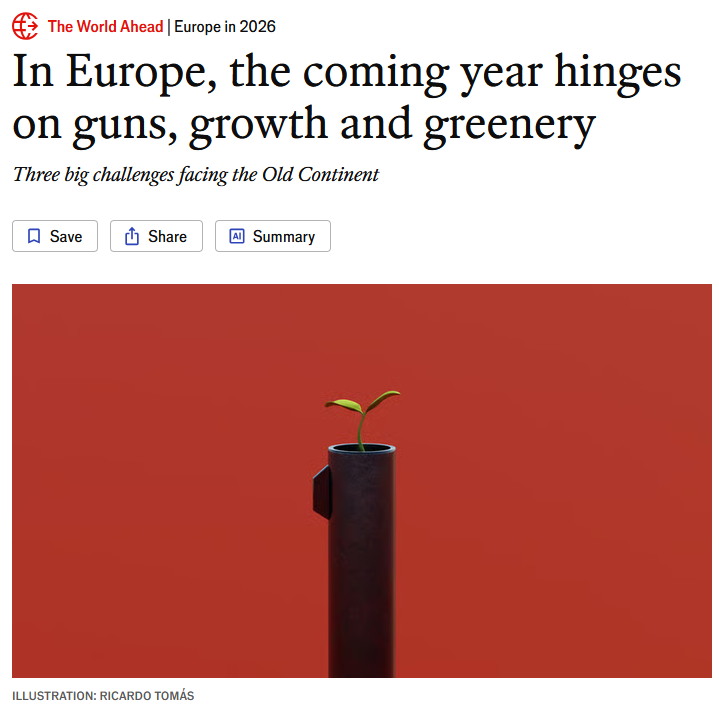
Europe enters 2026 squeezed from all directions. It needs to find the money to rebuild its military strength in the face of an increasingly hostile Russia, while expanding its support to Ukraine as America backs away. It must find a way to revive economic growth after years of underperformance, as protectionism spreads worldwide, or risk a further drift of unhappy voters towards the political extremes. And it must sustain its climate transition under relentless pressure from the populist right to water down or abandon its targets. Each of these tasks alone would be difficult. Together they are a nightmare.
Russia’s invasion of Ukraine in 2022 exploded decades of complacency—and the challenges are only mounting. Russia has been getting more provocative, cutting undersea cables in the Baltic, conducting a campaign of sabotage and assassination across the continent, and sending drones into Poland and Romania while its planes constantly and deliberately stray into NATO airspace. Expect all of this to persist, and worsen, in 2026. Donald Trump’s ambivalence towards America’s European allies has emboldened Vladimir Putin, so expect him to go on testing the limits as he seeks to divide and undermine NATO.Europe enters 2026 squeezed from all directions
Nearly all NATO members now meet the alliance’s defence-spending target of 2% of GDP, set in 2014. But now there is a new target, 3.5%, set at the June 2025 summit. And with the exceptions of Poland, Lithuania and Latvia, few members have even begun to explain to their voters how they will get there. Germany has been bravest: its chancellor, Friedrich Merz, has exempted defence from the Schuldenbremse (Germany’s debt brake) and has laid out a path to use this facility to hit the new target as early as 2029. Spain says it is not bound by the new number at all.
In 2026 Europe will spend more on defence than at any time since the cold war. Yet it is still far from attaining the “strategic autonomy” on which President Emmanuel Macron of France has rightly insisted. So expect 2026 to be dominated by a series of rows about where the extra money for defence, and for Ukraine, will come from. Very roughly, for the first three years of the war, America and Europe each contributed $50bn a year to Ukraine. America’s contribution has now dried up. Even if the war comes to an end, Ukraine will need support for years to come. In 2026, politicians will have to confront this fact.
It will also be another testing year for Europe’s economies. Inflation is easing and interest rates are ticking down, but growth is still sluggish and extra defence spending will not help much. Productivity growth has flatlined, ageing workforces are dragging down output, and venture-capital money and jobs are flowing to America and Asia. Debt-to-GDP ratios are over 100% in Italy, France, Spain and Belgium.
Public finances are strained by debts from the pandemic, by green subsidies and now by defence outlays. The strain will worsen in 2026, because weak governments have consistently proved unable to force through cuts to welfare and are terrified of raising taxes. In France, Mr Macron may call a snap parliamentary election to try to resolve the problem.
Germany’s new infrastructure push, a €500bn ($589bn) pot of cash, will begin to shift the mood a little. New roads, railways and power grids will attract private investment. Across the euro zone, a modest uptick in growth is projected, but still only to 1.2% from 0.8% in 2025. European exporters will continue to face high tariffs in America, their biggest market.
The third painful squeeze to watch in 2026 will be over climate policy. The EU’s ambitious targets to reduce greenhouse-gas emissions are meeting resistance. Along with slashing migration, opposition to green policies is a hallmark of the hard right, on the rise across the EU. Banning new petrol cars by 2035 and achieving net-zero emissions by 2050 both look increasingly unattainable. And there have been calls to water down the EU’s carbon-border-adjustment mechanism, which imposes tariffs on carbon-intensive imports and is supposed to come into force in 2026. In the coming year governments may be forced into a rethink, particularly if the hard-right National Rally wins a parliamentary election in France.
Europe has turned calamity into opportunity before. The euro crisis produced the first steps towards a banking union and a new lender of last resort; the pandemic led to joint borrowing; the war in Ukraine has prompted steps towards defence integration. Will 2026 see something as bold? Alas, it seems unlikely. ■