
Chinese leaders are playing a canny game
Nov 10th 2025| By David Rennie, Geopolitics editor and The Telegram columnist, The Economist
STRIP away the fine words about peace and solidarity, and China’s core offer in 2026 to countries being bullied by President Donald Trump is this: “You know where you are with us.” But that promise of predictability cuts both ways.
Countries that know China best—its neighbours and those reliant on its trade—know it as an unsentimental giant, bent on returning to the pinnacle of global power and increasingly willing to use its dominance in some sectors, such as the production of rare-earth minerals and permanent magnets, to coerce and intimidate foreign rivals. Chinese officials and state-backed scholars talk publicly of the need to dominate global manufacturing for decades to come. They call for a “realist” international order that offers “universal security” rather than universal values.
China does not deny being guided by self-interest, and is willing to show its strength. Still, it argues that its steely focus on economic development makes it a reliable—if occasionally alarming—partner in these troubled times, unlike the mercurial, chaotic Mr Trump. That does not mean that China proposes to fill every vacuum, or to supplant America as a global policeman. On the contrary, its diplomats deplore Western governments that use sanctions, military interventions or defensive alliances to uphold an “international rules-based order” that China calls a cover for Western liberal values. What China is offering in the developing world is its familiar mix of economic investments, loans, trade, infrastructure-building and vocational training, all on Chinese terms.
To prominent Chinese scholars of international relations, the second Trump presidency is a chance to notch wins in a global “narrative war”. America’s policy shifts have opened up numerous opportunities for China to increase its influence. Three stand out.
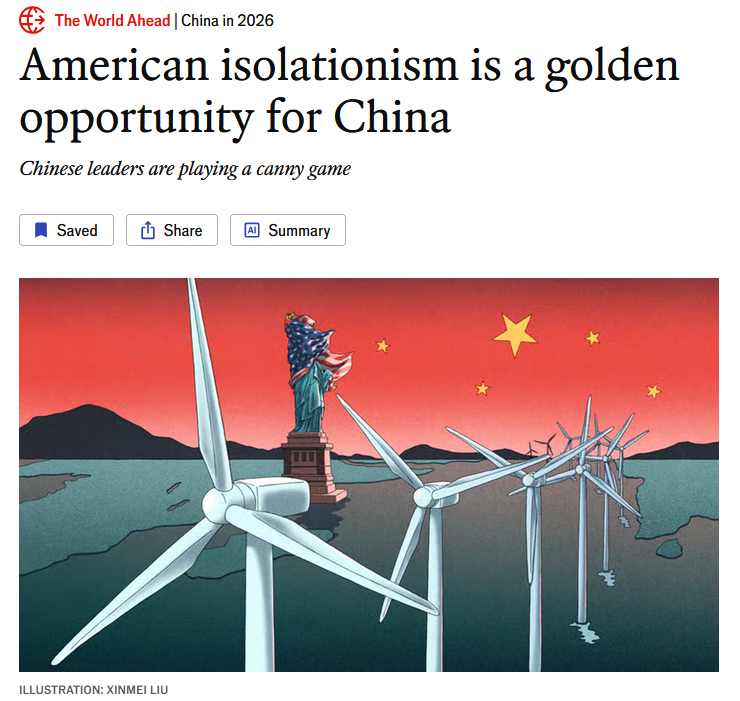
The first is clean tech. In his first presidency, Mr Trump was a sceptic about climate change and renewable energy. Since his re-election, he has cut subsidies for green technologies and berated foreign governments for shunning fossil fuels. Enter China, already a dominant provider of solar panels, wind turbines and advanced batteries, and an expert in building the smart electrical grids needed to knit green technologies together.The Trump presidency is a chance to notch wins in a global “narrative war”
Then there is Africa. In 2025 Mr Trump slapped 30% tariffs on South Africa, while Republicans in Congress threatened to curb tariff-free access offered to the poorest African countries under the African Growth and Opportunity Act. Right on cue, China extended tariff-free access to imports from 53 African nations, though many African governments mutter about unbalanced trade relationships, built on selling China raw materials in exchange for finished goods.
Third is India. During Mr Trump’s first term and the Biden administration, India edged closer to America, spurred by a shared wariness of China. That wariness was deepened by border clashes between Indian and Chinese troops. Yet in his second term, Mr Trump has demeaned India’s prime minister, Narendra Modi, and imposed punitive tariffs for buying Russian oil. In September Mr Modi went to China to join Russia’s president, Vladimir Putin, at a gathering hosted by China’s ruler, Xi Jinping. It brought together leaders of a regional grouping that India regards with suspicion, the Shanghai Co-operation Organisation. But Chinese scholars noted that Mr Modi’s embrace of their country had limits. As well as declining to join other foreign leaders in Beijing for a military parade to mark the 80th anniversary of victory over Japan, Mr Modi pointedly visited Japan en route to China.
Mr Trump’s unpredictability is thus helping China in its contest with America for global influence. China’s risk-averse diplomats may struggle with Mr Trump’s freewheeling statecraft. Mr Xi does not make policy on the fly. But strength matters more. At a Trump-Xi summit in South Korea in October 2025, Mr Trump lowered tariffs in exchange for China agreeing to buy soyabeans and advanced chips from America, and to sell rare earths: all trades that suit China.
Mr Xi has learned how to play Mr Trump, but his ideal outcome would be to need him less. China sees Mr Trump as a sign of American decline. It does not want to be dragged down by him. ■