Nov 10th 2025| By Tom Standage, Editor, The World Ahead 2026
This is Donald Trump’s world—we’re all just living in it. The disruptor-in-chief was the biggest factor shaping global affairs in 2025, and that will be the case for as long as he remains in the White House. His norm-shattering approach has caused turmoil in some areas (as in trade) but has also delivered diplomatic results (as in Gaza) and forced necessary change (as with European defence spending). As the Trumpnado spins on in 2026, here are ten trends and themes to watch in the coming year.
Expect to hear wildly diverging accounts of America’s past, present and future, as Republicans and Democrats describe the same country in irreconcilably different terms to mark the 250th anniversary of its founding. Voters will then give their verdict on America’s future in the midterm elections in November. But even if the Democrats take the House, Mr Trump’s rule by bullying, tariffs and executive orders will go on.
Foreign-policy analysts are divided: is the world in a new cold war, between blocs led by America and China, or will a Trumpian deal divide the planet into American, Russian and Chinese “spheres of influence”, in which each can do as they please? Don’t count on either. Mr Trump prefers a transactional approach based on instinct, not grand geopolitical paradigms. The old global rules-based order will drift and decay further. But “coalitions of the willing” will strike new deals in areas such as defence, trade and climate.
With luck, the fragile peace in Gaza will hold. But conflicts will grind on in Ukraine, Sudan and Myanmar. Russia and China will test America’s commitment to its allies with “grey-zone” provocations in northern Europe and the South China Sea. As the line between war and peace becomes ever more blurred, tensions will rise in the Arctic, in orbit, on the sea floor and in cyberspace.
All this poses a particular test for Europe. It must increase defence spending, keep America on side, boost economic growth and deal with huge deficits, even though austerity risks stoking support for hard-right parties. It also wants to remain a leading advocate for free trade and greenery. It cannot do all of these at once. A splurge on defence spending may lift growth, but only slightly.
China has its own problems, with deflation, slowing growth and an industrial glut, but Mr Trump’s “America First” policy opens up new opportunities for China to boost its global influence. It will present itself as a more reliable partner, particularly in the global south, where it is striking a string of trade agreements. It is happy to do tactical deals with Mr Trump on soyabeans or chips. The trick will be to keep relations with America transactional, not confrontational.With rich countries living beyond their means, the risk of a bond-market crisis is growing
So far America’s economy is proving more resilient than many expected to Mr Trump’s tariffs, but they will dampen global growth. And with rich countries living beyond their means, the risk of a bond-market crisis is growing. Much will depend on the replacement of Jerome Powell as chair of the Federal Reserve in May; politicising the Fed could trigger a market showdown.
Rampant spending on infrastructure for artificial intelligence may also be concealing economic weakness in America. Will the bubble burst? As with railways, electricity and the internet, a crash would not mean that the technology does not have real value. But it could have wide economic impact. Either way, concern about AI’s impact on jobs, particularly those of graduates, will deepen.
Limiting warming to 1.5°C is off the table, and Mr Trump hates renewables. But global emissions have probably peaked, clean tech is booming across the global south and firms will meet or exceed their climate targets—but will keep quiet about it to avoid Mr Trump’s ire. Geothermal energy is worth watching.
Sport can always be relied upon to provide a break from politics, right? Well, maybe not in 2026. The football World Cup is being jointly hosted by America, Canada and Mexico, whose relations are strained. Fans may stay away. But the Enhanced Games, in Las Vegas, may be even more controversial: athletes can use performance-enhancing drugs. Is it cheating—or just different?
Better, cheaper GLP-1 weight-loss drugs are coming, and in pill form, too. That will expand access. But is taking them cheating? GLP-1s extend the debate about the ethics of performance-enhancing drugs to a far wider group than athletes or bodybuilders. Few people compete in the Olympics. But anyone can take part in the Ozempic games.
Wherever you stand on performance-enhancing drugs, I hope you will find The World Ahead 2026 to be a valuable and effective supplement to your media diet, boosting clarity and foresight. ■
Daniel W. Drezner, Ulrike Franke, James Bosworth, Paul Poast
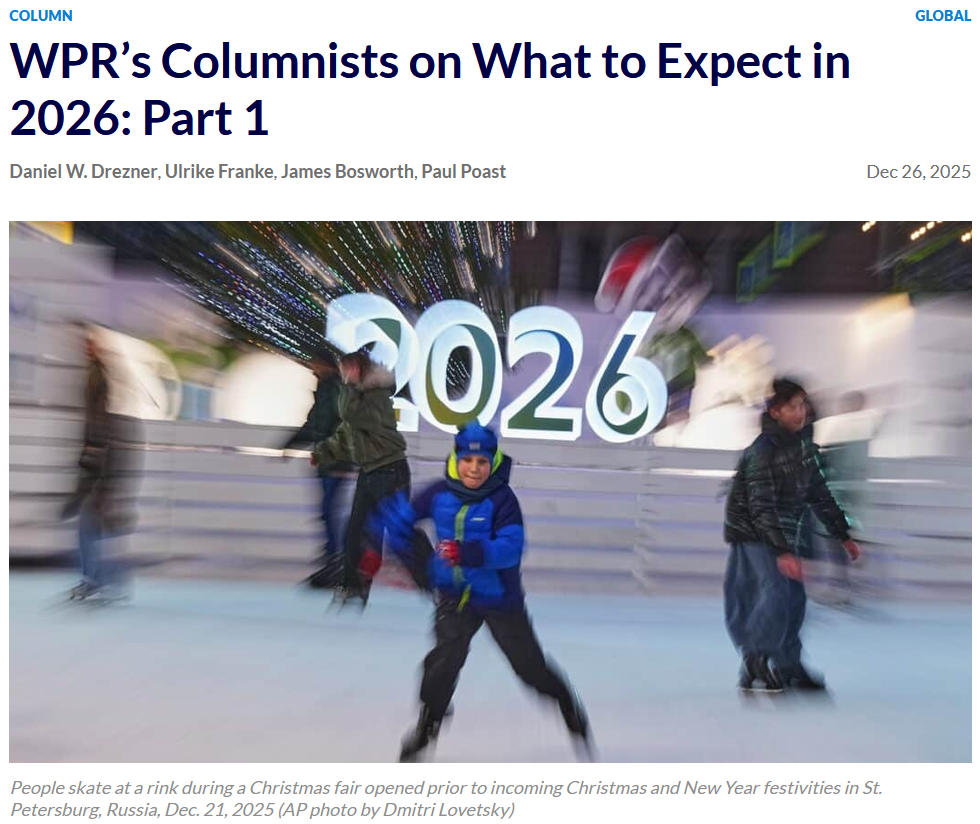
As 2025 comes to a close and we prepare to ring in a new year, WPR reached out to our columnists to ask what trends they’ll be keeping an eye on in 2026. The first installment of this year-end series is below. Part two will be published on Jan. 2.
Daniel Drezner, distinguished professor of international politics and academic dean at The Fletcher School of Law and Diplomacy:The United States—specifically, the Trump administration—was the biggest disruptive force in world politics over the past year. With its wholesale reorientation of U.S. foreign policy, the new administration succeeded in throwing other global actors off balance. In 2026, I will be watching for any signs of a backlash, and whether that backlash will affect the relative standing of great powers in the world.
Will U.S. partners and allies continue their policy of appeasement toward the Trump administration? For some countries, the lack of a better option means the answer will likely be yes. But as the revolution in U.S. foreign policy continues, European allies might (finally) get serious about hanging together so as to avoid hanging separately in the security sphere. Similarly, Latin American countries might need to weigh their options as the “Trump Corollary” to the Monroe Doctrine comes into focus. And China could seek to exploit such geopolitical fissures to advance its own interests.
It’s not just states: Individuals can respond as well. How much longer will the United States continue to attract the best and the brightest from the rest of the world? Will foreigners continue to seek educational and employment opportunities in the United States? Will foreign tourists flock to America’s shores to watch the World Cup in 2026? If the answer to these questions is yes, it will be a sign of the enduring appeal of American soft power. If not, then Donald Trump’s golden age will be very short-lived.
Ulrike Franke, senior policy fellow at the European Council on Foreign Relations: I will be keeping an eye on whether Europe’s decisionmakers and populace will adapt to the new realities we now live in. My columns this year have outlined this new world we live in: The trans-Atlantic relationship as we know it has ended. Europe is facing attacks from Russia. Germany is becoming a military power, as is Poland. The private sector is becoming an actor in geopolitics in a way it hasn’t for a long time.
Consciously, most decisionmakers understand these developments, and they are increasingly sinking in for everyday people as well. And yet, we are in a liminal moment where on a subconscious level, people still want to hold on to the old world. The changes are not really understood yet. Many hold out hope that the old order might return. Or else, they simply struggle to adapt to a world in which power relationships have changed and actors behave differently than before.
It is always difficult to say goodbye to what one considers normal, but this is exactly what is needed now. Europe needs to act according to the new realities it faces, not how it wishes the world to be. There is no point in holding out hope that the U.S. will return to the trans-Atlantic relationship. The acceptance of international laws, rules and norms is decreasing. Germany’s standing within Europe, and most likely its relationship with France, will change due to changes in relative military power. The faster Europeans internalize these changes, the faster we will be able to shape our reality, rather than just endure it. There is now a window of opportunity for changes—in the structure of the EU or the functioning of NATO, for example—that Europe should use to its advantage.
It is always difficult to say goodbye to what one considers normal, but this is exactly what is needed now.
James Bosworth, longtime political risk analyst focusing on Latin America and the Caribbean: The Western Hemisphere’s biggest story in 2025 was the intense focus that the Trump administration placed on the region. The year began with threats of military strikes targeting cartels in Mexico as well as statements about retaking the Panama Canal. It ends with the U.S. military having moved significant assets to the Caribbean to potentially target Venezuela while it also strikes alleged drug trafficing boats on both sides of the continent. U.S. policy will continue to be the big narrative in 2026, alongside questions about how other countries react.
The Venezuela narrative will be dominant. Will the U.S. escalate? Will Maduro leave? Will democracy be restored? It’s that last question that will drag out the entire year, even if there are early answers to the other two. There is no credible scenario where Venezuela magically returns to a normal country after years of economic collapse and dictatorship. Either President Nicolas Maduro remains and the struggle to dislodge him continues throughout the year, or Maduro leaves and a new power struggle emerges.
On the economic front, perhaps no story will be bigger than the renegotiations of the U.S.-Mexico-Canada trade agreement, or USMCA. There are rules for how these negotiations are supposed to occur, but the U.S. can be expected to try to bypass the rules and play its own game. Trump has threatened multiple times to withdraw from the USMCA and will use that threat again to attempt to extract concessions from neighboring leaders. Mexico’s Claudia Sheinbaum has proven to be a savvy negotiator over the past year, often prompting Trump to walk back his threats.
Elsewhere, there are elections scheduled next year in Costa Rica, Peru, Colombia, Haiti and Brazil. Each country has its own domestic political agenda that will dominate the discussion. However, here again, Trump seems quite likely to try to put his fingers on the scale in at least a few of these contests, just as he did in Ecuador, Argentina and Honduras in 2025. While Trump seemed to benefit from the outcomes of all three of those contests, it’s not clear whether he can successfully influence the ones to come.
It’s not ideal that the U.S. will continue to be so central to so many political debates throughout the Western Hemisphere. The region faces numerous economic, security and political challenges that deserve discussion on their own merits, with local decision-makers driving the conversation. The people of Latin America and the Caribbean don’t want to be treated as chess pieces pushed around by the U.S. and China. Given Washington will continue to focus intensely on the region, one expected outcome is an emerging backlash. Watch for politicians and civil society in Latin America and the Caribbean to push back against attempts by outsiders to influence political outcomes.
Paul Poast, associate professor in the Department of Political Science and deputy dean for doctoral education at the University of Chicago: The United States will be front and center in 2026. It will co-host the World Cup and the G20 Summit. It will celebrate the 250th Independence Day on July 4. And it will also hold crucial midterm elections in November, in which a strong showing by the Democratic Party could derail parts of Trump’s domestic and international agenda.
All of this means the world is about to get a lot more of Donald Trump. He’ll be campaigning to help protect Republican house and senate seats. He’ll use the World Cup and the G20—as well as his usual appearance before the U.N. General Assembly and other notable global summits—to continue espousing his America First agenda. And the United States Semiquincentennial celebrations are sure to be a spectacle.
Will any of this amount to substance? That remains to be seen. Indeed, for all of the turmoil and recrimination that the Trump administration caused this year, it is unclear to what extent his actions will have a lasting impact on the international system, let alone the United States.
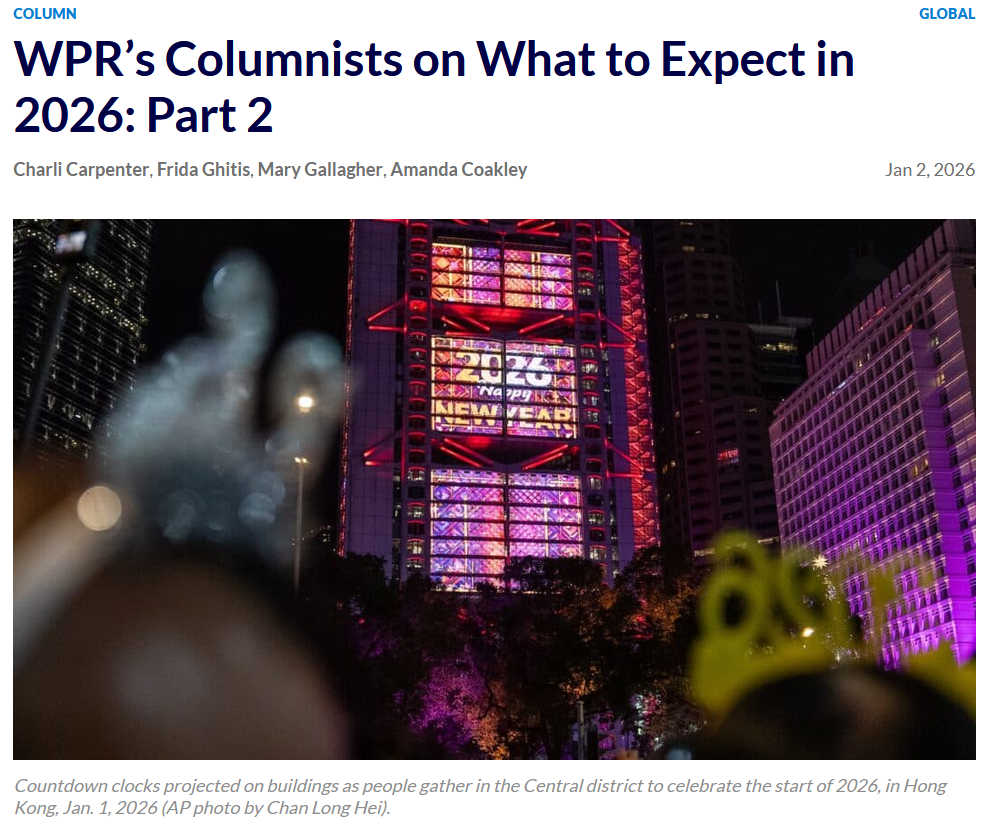
As 2025 came to a close and we prepared to ring in a new year, WPR reached out to our columnists to ask what trends they’ll be keeping an eye on in 2026. The second installment of this limited year-end series is below. Click here to read Part 1.
Charli Carpenter, a professor of political science and legal studies at University of Massachusetts-Amherst, specializing in human security and international law: One of the defining features of 2025 has been U.S. President Donald Trump’s effort to rewrite the global rules-based order. As I noted in my final column for 2025, violation of important global norms does not itself necessarily indicate those norms are weak. In fact, sometimes such violations can galvanize efforts to protect moral standards and strengthen taboos. At the same time, norm violators sometimes attempt to wield global norms for their own interests. This year, I’ll be following the dialectic between those who would overturn the rules-based order and those who would protect it.
One area in which norm dynamics are ever shifting concerns the use of inhumane weapons. Some treaty norms—including those against cluster munitions and landmines—are under strain in Europe, where Ukraine has opted to use cluster munitions in its war with Russia, followed by Baltic Europeans states signaling they will withdraw from the Ottawa Treaty banning landmines due to fears of a Russian invasion. But the ultimate impact of these choices will rest on the response from domestic and global civil society.
The nuclear taboo is another important case. While norms against nuclear possession appear to be flagging a bit, this may be enhancing the norm against nuclear use. Some evidence suggests mounting opposition to nuclear weapons from both civilians and military personnel.
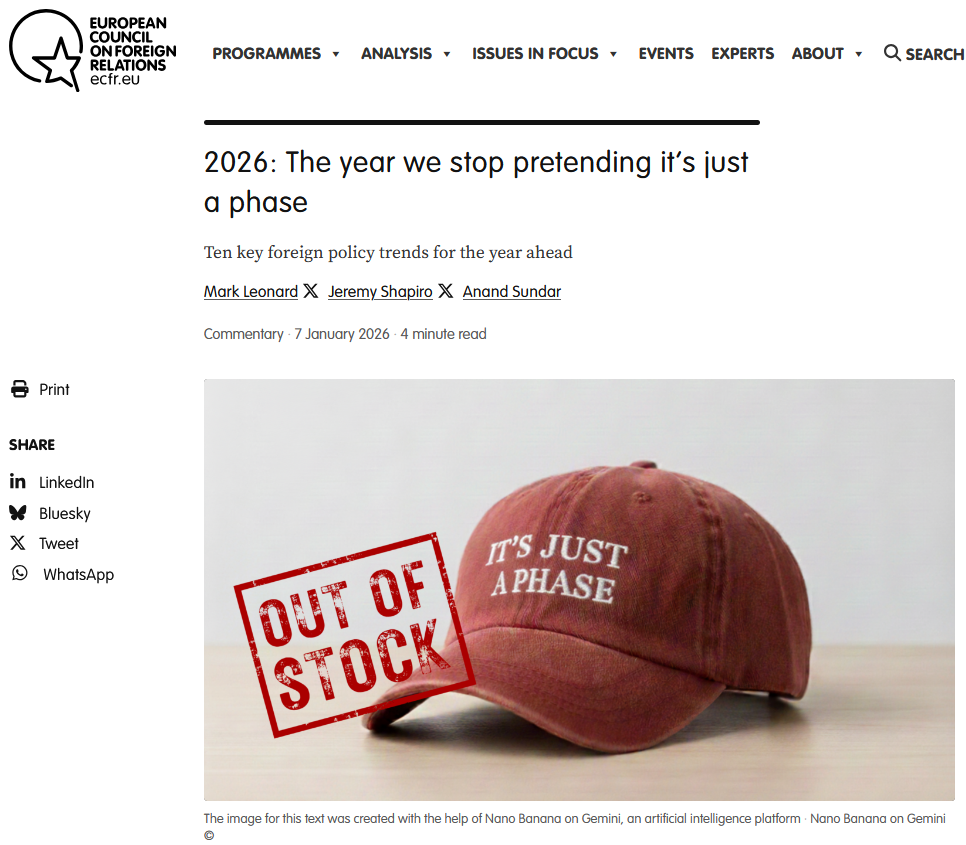
2026: The year we stop pretending it’s just a phase
This year, we decided to finally relinquish our state-of-the-art scoring algorithm to a less interested party. But lest things get out of hand, the authors have outsourced this thankless task to an ECFR colleague: Chris Herrmann, our intrepid US programme coordinator. It may explain why we did slightly less well than in previous years (despite achieving a nevertheless impressive 7 out of 10 points)—although this may also have something to do with the current, more volatile geopolitical situation.
The world will not fall apart in 2026, but its main institutions will be hollowed out; the links between countries will be weaponised; and we will continue to muddle through an illiberal wave which is clearly not just a phase
The main story of 2026 will be the further decay of the liberal order, driven as much by a crisis of legitimacy within the West as by the challenge from rising powers which feel under-represented within it. The world will not fall apart in 2026, but its main institutions will be hollowed out; the links between countries will be weaponised; and we will continue to muddle through an illiberal wave which is clearly not just a phase.
Here are our ten foreign policy trends for 2026—along with two bonus predictions.
Ten foreign policy trends
1. Europe normalises political decay, rather than reversing it
The far right makes further inroads across Europe. The Alternative for Germany (AfD) wins an outright majority in Saxony-Anhalt, breaking a psychological barrier more than a governing one. In France, prime minister Sébastien Lecornu’s government collapses under pressure from both left and right. In Britain, Labour’s poor performance in the May local elections triggers a leadership crisis that exposes the fragile balance between the party’s internal factions. None of this produces a continental emergency. Instead, European leaders quietly adapt to democratic erosion as a condition to be managed rather than defeated.
2. Trump strikes a “new” Iran deal that looks a lot like the old one
The Trump administration concludes an ambitious agreement with Iran that closely resembles the Obama-era Joint Comprehensive Plan of Action (JCPOA): nuclear restraint in exchange for sanctions relief. The difference lies in presentation rather than substance. This time, the deal includes explicit incentives for American companies to invest in Iran, has some unkind words of Iran’s ballistic missile programme and is framed as a commercial victory rather than a diplomatic compromise. International outrage proves fleeting; the agreement holds.
3. Europe’s techlash turns openly protectionist
Rising coercion from both China and the United States pushes Europe into a more confrontational regulatory stance. The European Commission levies large fines on X and other US tech companies, restricts their access to European markets and tightens enforcement of digital regulations. At the same time, new cybersecurity and industrial rules effectively block Chinese electric vehicles and renewable technologies from Europe. Strategic autonomy becomes the language through which old-fashioned protectionism is justified.
4. The US signals disengagement from Europe without dramatic withdrawal
Washington finally publishes its long-delayed Force Posture Review. It announces only modest troop withdrawals from Europe, disappointing both transatlanticists and restrainers. But the accompanying message matters more than the numbers. The administration makes clear that further reductions will follow unless Europeans assume far greater responsibility for their own defence. The threat is less abandonment than indifference.
5. Ukraine accepts an uneasy ceasefire it did not design
An uneasy ceasefire between Ukraine and Russia takes hold. It is driven by Ukrainian exhaustion and American insistence rather than European diplomacy. Kyiv accepts a fairly lopsided arrangement because the alternative is fighting Russia alone. Europe plays little role in shaping the deal and even less in enforcing it. The ceasefire unlocks elections and Ukraine’s Volodymyr Zelensky is replaced as president. The war does not exactly end, but it freezes into a legally unresolved and politically corrosive stalemate.
6. Pressure mounts on Britain to align economically with the EU—without progress
Domestic pressure grows on Britain’s prime minister Keir Starmer to pursue closer economic integration with the European Union, including joining the customs union. But official talks between London and Brussels continue to go nowhere. Britain drifts toward partial alignment through necessity rather than strategy, while both sides avoid formal commitments that would require political capital they no longer possess.
7. Democrats win the US House of Representatives, with little impact on governance
In the 2026 midterm election, Democrats retake the House by campaigning relentlessly on affordability and embracing a form of progressive economic nationalism. They fail to win the Senate. President Donald Trump declares the results a mandate and announces he will continue governing exactly as before. Democrats hold a lot of hearings but no Trump administration officials show up.
8. AI strengthens the state more than it disrupts society
Artificial intelligence reshapes state capacity faster than labour markets. Governments deploy AI to improve tax collection, surveillance, military logistics and regulatory enforcement. The immediate impact is not mass unemployment or social upheaval, but a quiet expansion of administrative power. States become more capable even as public trust continues to erode.
9. The Green Deal becomes the Khaki Deal
The “greenlash” of 2024 and 2025 hardens into a new policy reality. European governments talk less about climate leadership and more about “energy sovereignty”. Decarbonisation advances only where it serves strategic and military objectives, such as securing supply chains or supporting defence logistics. Climate policy survives, but only when it can pass a security test. If you want a solar panel in 2026, you had better paint it camouflage.
10. China does not invade Taiwan, again
China, focused on worsening internal economic problems, once more refrains from invading or blockading Taiwan. The non-event reinforces a global mood of grim satisfaction. The absence of catastrophe becomes the benchmark for success, lowering expectations for international politics even further.
Our two bonus predictions
Bonus prediction one: Gaza stabilises just enough for diplomacy to move on
An uneasy ceasefire in Gaza holds long enough for Israel to claim it has made peace. Saudi Arabia and Israel conclude an effective expansion of the Abraham Accords, gradually normalising relations. As part of the arrangement, Trump offers Saudi Arabia a security guarantee similar to the one he extended to Qatar in 2025.
Bonus prediction two: Global south debt troubles deepen without a single crisis moment
Sovereign debt problems across the global south intensify, but without producing a single systemic crisis. Defaults, restructurings and rollovers continue in a fragmented, country-by-country fashion. There is no Bretton Woods moment, only mounting political pressure, constrained reform and rising populism across many indebted states.