
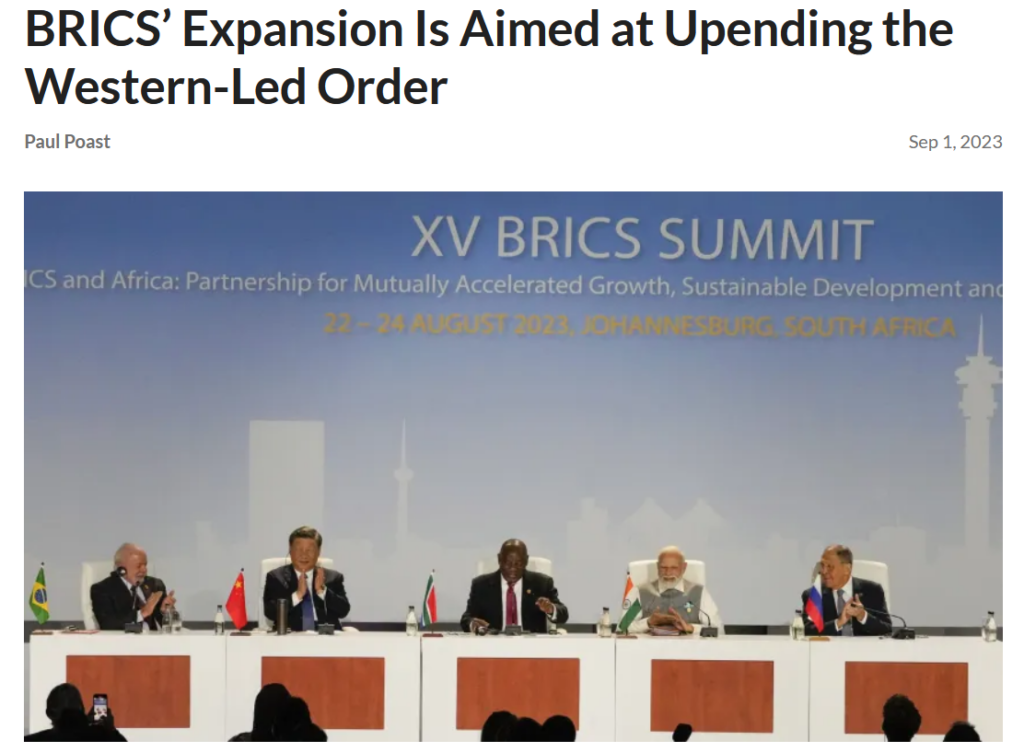
A group of five will soon be a concert of eleven. At last week’s summit of the BRICS nations, Brazil, Russia, India, China, and South Africa agreed to invite Ethiopia, Argentina, Iran, Egypt, Saudi Arabia, and the United Arab Emirates to officially join the group on Jan. 1, 2024. The new BRICS, or what might be called BRICS+, will soon be comprised of nations with nearly five times the population and more than 20 percent greater economic output than the G7 grouping of wealthy industrialized nations.
Some see the expanded BRICS as a “new alliance” that will soon “overtake” Western-led institutions such as the G7 and NATO. Others lampooned the announcement, seeing BRICS as a “fake” institution lacking a clear vision or coherence. Others were measured, acknowledging that while the group hasn’t yet accomplished anything concrete, it carries great potential. For instance, Singapore-based geopolitical risk analyst Gokul Sahni remarked that the enlarged BRICS “could possibly serve as a counterweight to the G7 in terms of scale,” while Christopher Weafer, CEO of Macro-Advisory consultancy, said BRICs “is now starting to emerge” as a viable bloc to counter western dominance in the global economy.
Last year’s summit was significant for how it contrasted with the G7 meeting, which was held almost simultaneously. At last year’s summit, the BRICS states began articulating a vision for a “new era” in economic development built around an alternative vision for global governance, one that is more inclusive and less Western-dominated. With this year’s decision to expand, those words are now manifesting into action. Indeed, BRICS and its message seems to carry a certain appeal, as apparently as many as 40 nations wish to join the bloc.
To be clear, BRICS, or whatever it will now be called, is far from being a unified group. It is not a formal international organization, as the grouping does not even have a functioning website. Several of the nations, notably existing members China and India and new members Iran and Saudi Arabia, are and remain staunch geopolitical rivals, while others have profound economic challenges from debt and inflation to slow growth.
Given these facts, it is important not to overhype the BRICS expansion decision. But the expansion of BRICS to BRICS+ is still notable for three critical reasons.
First, it underscores continued dissatisfaction with the U.S.-led economic order. Upon entering office, U.S. President Joe Biden declared that “America is back,” ready to engage the world system fully after years of President Donald Trump taking a more belligerent approach. But with their actions, from refusing to fully comply with economic sanctions against Russia to opting for a new-type of non-alignment, many nations throughout the Global South are demonstrating that they are uninterested in such overtures.
The mere calls for a dollar alternative illustrate how the BRICS+ nations chafe at U.S. dominance of the economic order.
Such dissatisfaction is most evident in calls to move away from the dollar as a global reserve currency, and perhaps even create a new unified new currency, “BRICS bucks” if you will. To be clear, such calls are nothing more than words at the moment. None of the current BRICS members, including China, seem willing to allow their financial markets to have the widespread openness required for their own currency to be a global means of settlement. Several members of the expanded BRICS grouping, such as Brazil and Saudi Arabia, would likely wish to retain access to the U.S. market, given strong economic ties. And consider that the key economic and financial initiative actually pursued by the BRICS, the New Development Bank, is essentially defunct.
But while the dollar’s strong position in the global economy, including among the members of BRICs, is secure, the mere calls for a dollar alternative illustrate how the BRICs+ nations chafe at U.S. dominance of the economic order.
Second and related, BRICS expansion points to China’s efforts to create an alternative world order, rather than seeking to work within the existing order. This expansion effort appears to have been spearheaded by China, leading some to label the collection of nations the “China plus 10 group.” At the summit, Chinese President Xi Jingping issued a scathing rebuke of the existing U.S.-led order. In a speech delivered on his behalf by China’s Commerce Minister Wang Wentao, Xi proclaimed that the United States was “obsessed with maintaining hegemony [and] has gone out of its way to cripple the emerging markets and developing countries.”
Such words will inform debates in Washington about whether China is seeking to overturn the U.S.-led order, or instead seeking to work within the institutions established and long-dominated by the United States. It is becoming increasingly clear that China is seeking to do the former, viewing the current system as rigged against it and developing countries. While Brazil’s President Luiz Inácio Lula da Silva tried to strike a more moderate tone, saying the group’s members are only trying “to organize ourselves” and have no desire to “be a counterpoint to the G7, G20, or the United States,” BRICS’ goal of countering the West was reiterated by China’s close ally, Russia’s Vladmir Putin, in his virtual remarks.
Third, the BRICS expansion points to how nations are seeking to prepare for transitioning the global economy away from dependence on carbon. It cannot be denied that a defining feature of BRICS+ is that it is comprised of several major oil and gas producers. Saudi Arabia, Iran, Russia are all major oil producers, while China and India are major oil consumers.
Of course, there already exists a well-known entity focused on coordinating the actions of these commodity producers, the Organization of the Petroleum Exporting Countries, or OPEC, along with the broader grouping (which includes Russia) of OPEC+. But OPEC and OPEC+ are made up of petroleum exporters. In contrast, BRICS+ brings together key oil producers and growing oil consumers in China and India. Having an organization in which consumers and producers can coordinate together makes sense given how the global economy will gradually move away from oil consumption. While the global economy and the members of BRICS+ are far from entering a post-carbon economic world, BRICS+ sets the foundation for coordinating needed adjustments as that future nears.
As aptly described by development sociologist Patrick Heller, BRICS is a “sort of anti-colonial reflex” to the economic domination of Europe and the United States. The BRICS nations, both new and old, are taking seriously the idea of creating an alternative, non-Western economic order. Even if the grouping has not yet accomplished anything concrete, the message of dissatisfaction it sends to the United States and Western nations is deafening.
Paul Poast is an associate professor in the Department of Political Science at the University of Chicago and a nonresident fellow at the Chicago Council on Global Affairs.